More security risk
More AI-generated code means more changes to check, and more chances for a vulnerability to slip through to production.
A conversation about software delivery
faster coding with AI agents
Augment, 2026of DevOps teams achieve elite delivery performance
DORA, 2024of outages are caused by changes to live systems
Google SRE BookAI assistants have made writing code dramatically faster, but gates, approvals and release coordination haven't kept up. Google's 2025 DORA research calls AI an amplifier: it magnifies the strengths and the weaknesses of whatever delivery system it lands in.
More AI-generated code means more changes to check, and more chances for a vulnerability to slip through to production.
The same checks everywhere slow down internal tools, while critical services still queue behind them.
A fast-moving team ships before the services around it are ready, and the incident lands on someone else.
The trade-off
Neither option keeps up with the volume of change AI-assisted teams now produce.
Manual deployments, human review, dedicated test environments and long soak tests. Adding people isn't fixing it.
It doesn't scale with AI-assisted output.
Skip the slow steps and you also skip the safeguards that keep production stable.
Incidents ship faster too.
Goldline is built so you don't have to choose.
How teams approach platform work
In a survey of 73 teams, hybrid build-and-buy approaches and self-managed open-source stacks were both common. Each reflects a different balance of control, integration and ongoing work.
run a hybrid build-and-buy approach
use a self-managed open-source stack
Doing nothing remains the most common choice. For many teams, the current setup feels good enough.
Introducing Goldline
Any code. Your policies. Every gate runs the way your policy defines it: automated rules, AI review, human approval, or a mix.
Transparency
Services and real dependencies, discovered for you.
Confidence
Know what a change affects before you deploy it.
Insight
See where time is lost between commit and release.
Efficiency
Isolated deployments, on demand.
Safety
Managed releases with a defined way back.
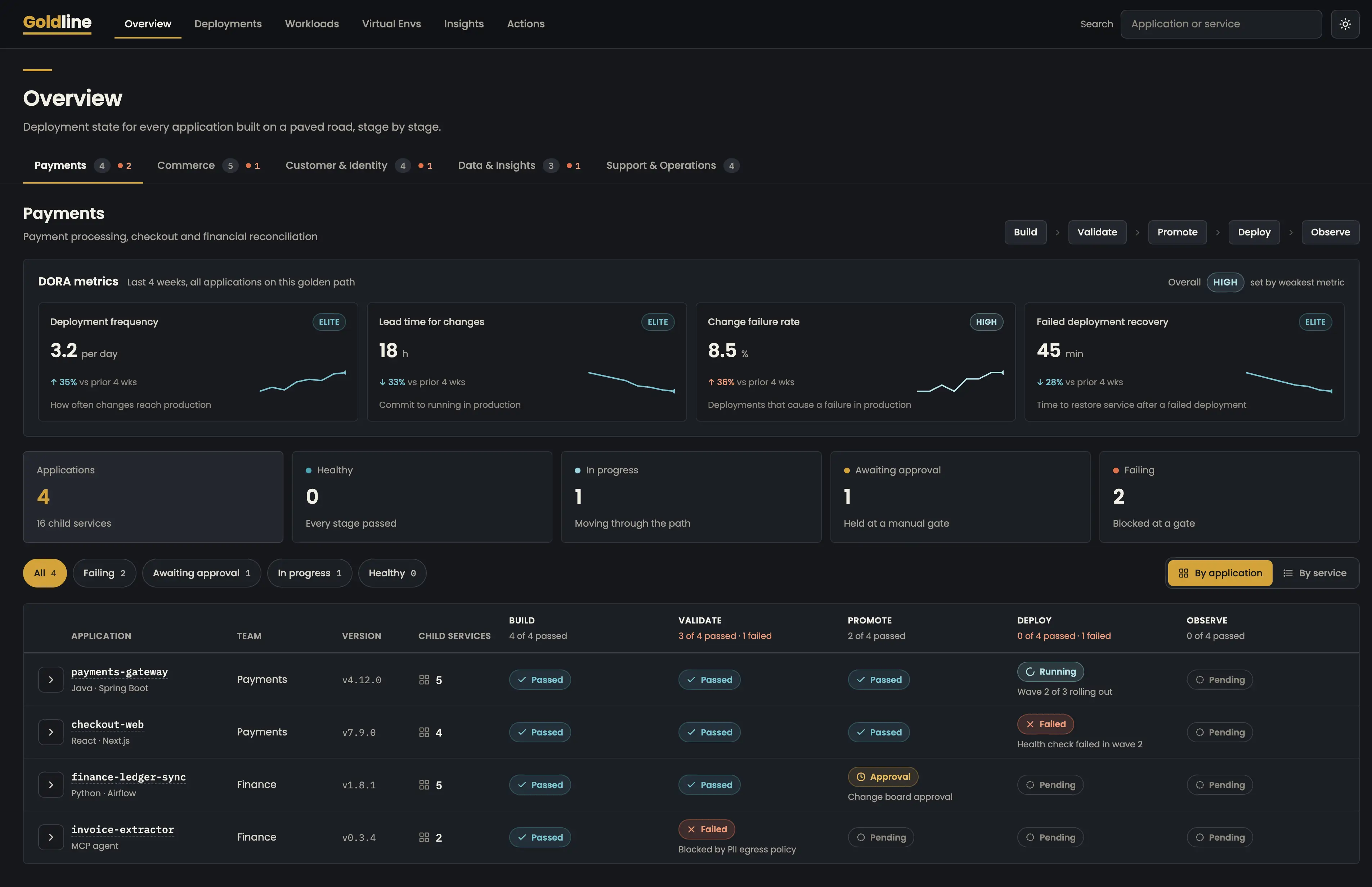
Goldline dashboard
Speed without compromise.
Governance without gridlock.
Goldline helps platform teams and engineering leaders understand where handoffs, environments and dependencies slow the path to production.
DORA metrics, application health, release stages, and deployment status in one view.
Who it's for
One path from code to production, with something different in it for each role.
Ship AI-assisted changes without waiting on the pipeline.
For developersPredictable releases, within working hours.
For release managersExtend your platform's reach without building every workflow.
For platform teamsTurn AI-assisted speed into measurable delivery performance.
For engineering leadersTry it on your own code
A short, scoped pilot on one representative application. No platform migration, and no commitment beyond it.
How the pilot worksBook a demo
Leave your details and we’ll set up a call: a short demo, then a 30-minute readiness assessment for one of your applications.
Prefer email? info@pytilia.ioWe’ll reply to you personally by email
Hi! 👋 Thanks for stopping by.
Tell us a little about what you’re working on, and one of the team will get back to you.